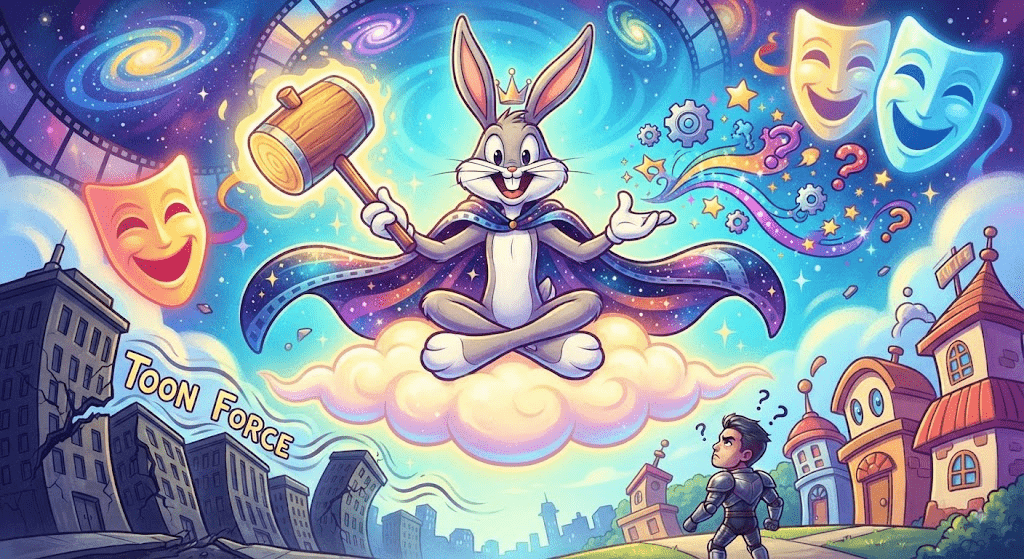

Are you confused by terms like toon god while debating which cartoon character could win a fight? You likely encounter characters who ignore physics, rewrite reality, and survive impossible odds. This concept, often called Toon Force, represents the peak of animated power. Understanding this helps you see why iconic figures remain unbeatable in cross-universe battles.
What Does “Toon God” Mean in Animation?
The term toon god acts as a classification for characters who possess absolute control over their narrative reality. Unlike standard superheroes who follow set rules, a toon god treats the laws of physics as mere suggestions. They utilize “Toon Force”—a reality-warping trait—to create objects from thin air, survive total erasure, and manipulate the fourth wall.
Toon Force: The Foundation of the Toon God
Toon Force is the underlying mechanics behind every toon god. It allows characters to operate based on the rules of comedy rather than logic. If something is funnier, it happens.
- Logic Immunity: Gravity only applies if the character looks down.
- Inventory Manifestation: Pulling anvils or hammers out of nowhere.
- Resilience: Surviving explosions or falls with only a bit of soot on their face.
Famous Examples of Toon God Archetypes
While “Toon God” is rarely an official title in scripts, fans use it to describe high-tier reality warpers. These figures consistently demonstrate powers that surpass cosmic entities.
| Character | Known For | Why They Are a Toon God |
| Bugs Bunny | Reality Warping | Rewrites animation cells to escape danger. |
| Popeye | Narrative Control | Can punch his way out of the film strip. |
| The Mask | Infinite Creativity | Turns reality into a living cartoon landscape. |
| SpongeBob | Elasticity | Can unmake and remake his body instantly. |
The Toon God in Fan Fiction and Gaming
In specific communities, such as the Toon Wars fandom, a toon god appears as a literal antagonist. These versions represent a darker take on the trope, acting as multiversal threats who seek to dismantle reality. Additionally, in custom card games like Yu-Gi-Oh!, fans create “Toon God” cards to represent these god-tier power levels.
Distinction: Toon God vs. Plot Armor
It is vital to distinguish between a toon god and simple “plot armor.” Plot armor happens when a character survives because the writer needs them to live. A toon god survives because their abilities dictate that they cannot lose. Their agency is absolute—they control the joke, and the joke controls reality.
Why Fans Rank Characters as Toon Gods
Power scaling debates often utilize the toon god label to level the playing field. When pitting a grounded hero against a cartoon icon, the toon character usually wins because they operate outside the “rules” of the fight. Their power is subjective, scaling infinitely to match the level of absurdity required to win.
Can a Toon God Be Defeated?
Generally, no. A true toon god remains immune to standard attacks like lasers, swords, or psychic blasts. Defeating them requires “cheating” the narrative—such as using an eraser to remove them from the screen or trapping them in a medium where their abilities don’t function.
Common Misconceptions About Toon Power
Many viewers assume all cartoon characters are toon god level. This is inaccurate. Only characters with high-level reality manipulation qualify. A character like Wile E. Coyote, despite using cartoon gadgets, often loses because he lacks the “god-tier” agency to force a win.
The Role of Humor in Power
Humor acts as the fuel for every toon god. The more chaotic or slapstick the situation, the stronger the character becomes. If a serious, god-like character enters a toon world, they often lose their edge because they fail to adapt to the irrational nature of the setting.
Cultural Impact of Toon Entities
The toon god archetype challenges how we view strength in fiction. It suggests that creativity and unpredictability are superior to raw physical force. This trope reminds audiences that at the heart of animation, the goal is entertainment—and nothing is more entertaining than a character who defies all limits.
Frequently Asked Questions
1. Is “Toon God” an official character title?
It is primarily a fan-made term used to describe characters with high-level Toon Force. However, it appears as a specific antagonist title in certain wiki-based crossover fan fictions.
2. Does every cartoon character have Toon Force?
No. Toon Force is reserved for characters who explicitly ignore physical laws for comedic effect. Many animated characters follow realistic rules.
3. Who is the most powerful Toon God?
Bugs Bunny is widely cited as the ultimate toon god due to his complete control over the medium, including interacting with animators and background art.
4. How is a Toon God different from a standard reality warper?
Standard reality warpers usually follow internal rules or magic systems. A toon god operates solely on the logic of humor, making them unpredictable.
5. Can you stop a character with Toon Force?
Only by using narrative-breaking methods, such as erasing their source material or nullifying their ability to be “funny” in the current context.
6. Is “ToonGod” an app?
Yes, “ToonGod” is also the name of a popular mobile application used for reading manga and manhwa, unrelated to the animation trope.
Final Thoughts
Whether you are analyzing cartoon physics or just enjoy debating character strength, the toon god remains one of the most fascinating concepts in media. These characters prove that imagination always triumphs over brute force.
What cartoon character do you think deserves the title of Toon God? Share your favorite reality-warping moment in the comments below!
Sources:
You May Also Read More : toon god