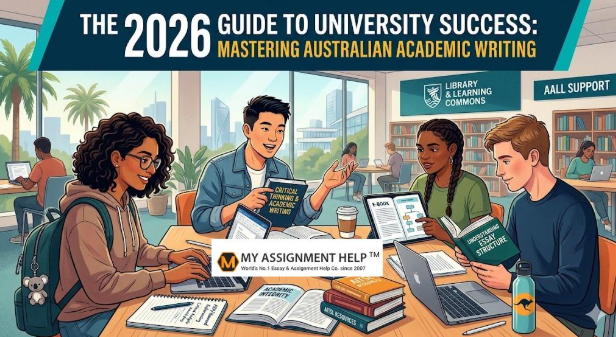

Transitioning from secondary school to university in Australia involves more than just a change in campus; it requires a fundamental shift in how you communicate ideas. Whether you are navigating the high-pressure ATAR requirements in Year 12 or entering your first year of a Bachelor’s degree at a Group of Eight (Go8) institution, mastering academic writing is the single most effective way to secure high marks and ensure long-term success.
In the Australian higher education landscape, institutions like the University of Sydney, ANU, Monash, and Western Sydney University place a heavy emphasis on critical analysis, structural integrity, and adherence to specific referencing styles. This guide breaks down the essential pillars of academic writing to help you climb the search rankings of academic excellence and thrive in a digital-first learning environment.
1. Understanding the Australian Academic Context
Australian universities operate under the Tertiary Education Quality and Standards Agency (TEQSA) framework. This regulatory body ensures that higher education providers maintain rigorous standards. For a student, this means your work is judged not just on “getting the answer right,” but on the transparency of your process and the integrity of your research. This is often why students seek out the best assignment help Australia has to offer, ensuring their work aligns with these high institutional expectations.
Unlike casual writing or even some forms of creative storytelling, academic writing in Australia is:
- Objective: Focusing on facts and evidence rather than personal opinion.
- Analytical: Asking “why” and “how” rather than just “what.”
- Structured: Following logical progressions that lead the reader to a clear conclusion.
- Localized: Adhering to Australian English standards (e.g., using ‘s’ instead of ‘z’ in words like organise) and regional socio-political contexts.
2. The Foundation: Planning and Deep Work
Success in academic writing starts long before you type the first word. High-achieving students utilize productivity frameworks to manage the cognitive load of complex assignments.
The Power of Deep Work
In an era of constant notifications, the ability to focus without distraction is a superpower. Dedicate “Deep Work” blocks of 90 minutes to your research phase. During this time, your only goal is to synthesize information from peer-reviewed journals. This prevents the “fragmented attention” that leads to weak arguments and surface-level analysis.
Decoding the Prompt: The Table of Directive Verbs
Before writing, you must identify the directive verbs in your assignment rubric. These verbs dictate your entire methodology. For instance, if you are looking for cost accounting assignment help , you’ll find that “Analyze” often refers specifically to variance or overhead allocation. Missing the intent of these verbs is the most common reason students fail to reach a “Distinction” grade.
| Directive Verb | What the Marker Expects |
| Evaluate | Assign value or judge the effectiveness of a concept using evidence. |
| Analyze | Break a complex topic into smaller parts to understand its internal relationships. |
| Synthesize | Combine different ideas/sources to create a new, cohesive argument. |
| Critique | Provide a balanced assessment of strengths and weaknesses; do not just “bash” the theory. |
| Contrast | Focus specifically on the differences between two or more frameworks. |
Strategic Outlining
A 1,500-word essay requires a robust roadmap. Spend at least 20% of your time on an outline. This ensures that your “Line of Argument” remains consistent from the introduction to the final sentence.
3. Structural Excellence: The Anatomy of a High-Distinction Paper
In Australia, the TEEL structure is the gold standard for paragraph construction. It ensures that every sentence serves a specific purpose in supporting your thesis.
The Introduction (10% of word count)
Your introduction should act as a funnel. Start with a broad context, narrow down to the specific problem, and end with a strong Thesis Statement. A “roadmap” sentence at the end of your intro—telling the reader exactly what points you will cover—is highly encouraged in the Australian system to provide clarity to the marker.
The Body Paragraphs: The TEEL Method
- Topic Sentence: State the main idea of the paragraph clearly.
- Explanation: Elaborate on the idea in your own words, showing your understanding.
- Evidence: Support your claims with data, quotes, or findings from credible sources.
- Link: Connect the paragraph back to your central thesis or the next point of discussion.
The Conclusion (10% of word count)
Never introduce new information here. Instead, synthesize your findings and restate your thesis in light of the evidence provided. A high-distinction conclusion often points toward the broader implications of the research or suggests areas for future study.
4. Developing a Critical Voice
One of the biggest hurdles for students is moving from descriptive writing to critical writing. Markers are looking for “originality of thought”—your ability to weigh evidence rather than just reporting it.
- Descriptive: “The study found that 60% of students feel stressed.”
- Critical: “While the study indicates 60% of students feel stressed, the methodology fails to account for external socio-economic factors in Western Sydney, suggesting a need for a more holistic research approach.”
Critical writing demonstrates to your tutors that you are not just a consumer of information, but a thinker who can challenge established norms and identify gaps in existing literature.
5. The Role of Evidence and Referencing
In the Australian system, failing to reference correctly is a breach of academic integrity. Most Australian universities utilize APA 7th, Harvard, or AGLC4 (for Law students).
Finding Quality Sources
Rely on databases like Google Scholar, JSTOR, or your university’s library portal. Avoid using Wikipedia or non-credible blogs as primary evidence. For students looking for specific assistance in navigating complex marking rubrics, exploring specialized Australian academic support can provide the edge needed to identify high-tier credible sources and understand the nuances of various citation styles.
Integrating Evidence
Avoid “quote dropping”—where a quote is placed in a paragraph without context. Every piece of evidence should be framed by your own analysis. Use signal phrases such as:
- “Contrary to the findings of…”
- “Building upon the framework established by…”
- “As articulated by [Author], the phenomenon of…”
6. Overcoming Academic Burnout with Agentic AI
In the 2026-2027 academic cycle, the integration of AI is no longer a luxury—it is a necessity for digital literacy. The key is Agentic Literacy: using AI as an “agent” or partner rather than a replacement for your own intellect.
Ethical AI Workflows
- Brainstorming: Ask AI to “Suggest three opposing views to my thesis on Australian macroeconomics.”
- Logic Checking: Use AI to “Critique the logical flow of these three paragraphs and identify any non-sequiturs.”
- Summarization: Ask AI to “Summarize the key arguments of this 50-page PDF so I can decide if it’s relevant to my research.”
This keeps you in the driver’s seat of your education. You are the “Manager” of the AI, ensuring that the final output is 100% your own unique perspective and voice.
7. Polishing: The Editing and Proofreading Phase
High-achieving students never submit a first draft. In Australia’s competitive environment, clarity and conciseness are key.
- The 24-Hour Rule: Finish your draft and step away for at least a day before editing. This helps you spot logical gaps and awkward phrasing.
- Check for Nominalization: Instead of saying “When we analyzed the data,” use “The analysis of the data…” to maintain a formal, objective tone.
- Australian English Check: Ensure your word processor is set to English (Australia). Misspelling “centre” as “center” or “labour” as “labor” can subtly signal a lack of attention to regional academic standards.
8. Specific Tips for the 2026 Academic Cycle
The landscape of education is changing rapidly. To stay ahead:
- Focus on Learning Outcomes: Every unit guide contains “Learning Outcomes.” Ensure your essay explicitly proves you have met these goals.
- Seek Feedback Early: Don’t wait until the final week. Use tutor office hours or peer-review groups to refine your arguments.
- Utilize Academic Resources: For those seeking deeper insights or tailored support in mastering these skills, exploring comprehensive academic resources can provide the necessary tools to excel in a high-pressure environment.
Conclusion
Improving your academic writing is a journey of incremental gains. By focusing on the TEEL structure, developing a critical voice, and adhering strictly to TEQSA-aligned integrity standards, you position yourself for success in any Australian university course.
Academic success is not just about how much you know; it is about how effectively you can communicate that knowledge. In 2026, combining traditional structural excellence with modern agentic literacy is the winning formula for the next generation of Australian graduates.
Frequently Asked Questions
Q.1 What is the difference between high school and university writing in Australia?
In high school, particularly during the ATAR years, the focus is often on demonstrating that you have learned the curriculum. At the university level (High School and above), the expectation shifts toward originality and critical evaluation. Tutors are less interested in a summary of facts and more interested in your ability to weigh competing arguments and identify the limitations of existing research.
Q.2 Why is the TEEL structure so important for Australian students?
The TEEL (Topic, Explanation, Evidence, Link) structure provides a logical framework that mirrors the “critical thinking” requirements of Australian marking rubrics. It ensures that you never provide evidence without explaining its relevance to your thesis. Following this structure is often the fastest way for a student to move from a “Pass” to a “Distinction” grade.
Q.3 Is using AI considered plagiarism in Australian Universities?
This depends on the specific policy of your institution (e.g., University of Melbourne vs. UNSW). Generally, using AI to generate an entire essay is considered a breach of academic integrity. However, Agentic AI—using tools for brainstorming, outlining, or proofreading—is increasingly viewed as a vital digital skill. Always check your unit guide for “AI use” declarations.
Q.4 How do I know which referencing style to use?
Most faculties at Australian universities have a preferred style. For example:
- Law: AGLC4 (Australian Guide to Legal Citation).
- Business/Science: APA 7th or Harvard.
- Humanities: MLA or Chicago.
Always refer to your university’s library website for the most current referencing “cheat sheets.”
Q.5 Can I get professional help for my university assignments?
Yes. Many students seek external support to understand complex feedback or to learn how to structure their arguments more effectively. Utilizing specialized academic support services can help bridge the gap between high school writing and the rigorous demands of higher education, provided they are used as a learning tool to improve your own academic skills.
About the Author – Drake Miller
I am a dedicated blog author associated with Myassignmenthelp.services, where I create informative and engaging content for students worldwide. My focus is on simplifying complex academic topics, sharing practical study tips, and guiding learners toward academic success. Through my writing, I aim to support students with reliable insights, helping them manage assignments, deadlines and overall educational challenges effectively.