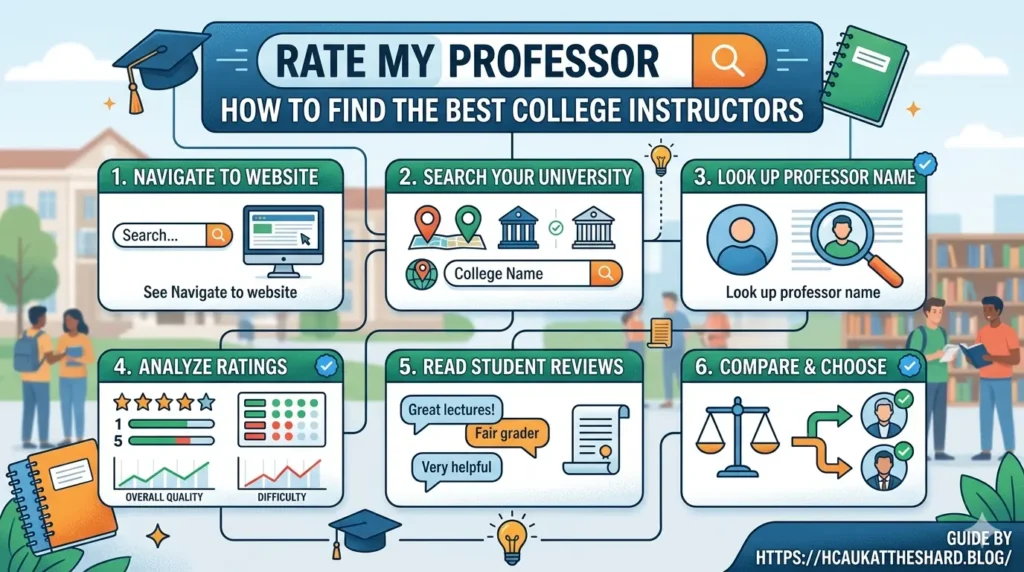

Struggling to build the perfect college class schedule? Choosing the wrong instructor can ruin your semester, tank your GPA, and waste your hard-earned tuition money. Fortunately, you can take control of your academic journey right now Rate My Professor. This definitive guide shows you how to navigate student reviews, decode grading patterns, and select the best educators for your degree.
What Is and How Does It Work
Students across the globe rely on digital platforms to share honest feedback about their classroom experiences. The primary tool for this research is Rate My Professor, a massive online database containing millions of reviews from real undergraduates and postgraduates. It allows users to grade faculty members based on difficulty, teaching clarity, and overall helpfulness.
By analyzing these collective reviews, you gain immediate insights into a classroom dynamic before day one. The system operates on user-generated data, meaning students upload individual ratings after finishing a course. This transparency helps the academic community make informed decisions during registration periods.
Why You Need to Research Instructors Before Registration
Enrolling in university courses without researching faculty is a major financial and academic risk. A brilliant educator inspires career growth, while a poor match can lead to dropped classes or low grades. Checking feedback beforehand helps you align your personal learning style with an instructor’s specific teaching methodology.
Furthermore, preparation reduces registration anxiety. When you know an educator’s testing habits and homework expectations, you can balance your weekly study schedule effectively. Academic success relies heavily on pairing your effort with compatible mentorship.
How to Filter Search Results for Specific Universities
Navigating a massive database requires precise filtering to find relevant local data quickly. To look up a specific faculty member, you must first input the exact campus location to eliminate matching names at other institutions.
For instance, searching for faculty at large state schools requires distinct campus filters. Students looking for data at the University of Georgia should specifically search the rate my professor uga portal. Similarly, individuals attending Texas State University need to use the rate my professor txst page to ensure they view local Texas faculty instead of out-of-state namesakes.
Decoding the Rating Metrics: Overall Quality vs. Difficulty
The platform breaks down scores into distinct metrics, primarily Overall Quality and Level of Difficulty. The Overall Quality score uses a five-star scale, where higher numbers indicate excellent student satisfaction. However, a high quality score does not always mean an easy class.
The Level of Difficulty score tells you exactly how much effort you must invest to earn a top grade. A difficulty rating of five means intense coursework and rigorous grading. Balancing your schedule means pairing high-difficulty major courses with lower-difficulty electives.
Spotting Fake Reviews and Extreme Bias on the Platform
Not every comment on the internet reflects reality. When reading student feedback, you must learn to identify emotional bias and extreme outliers. Software systems and human moderation filter out clear spam, but some skewed reviews still slip through the cracks.
Watch out for these common warning signs:
- The Vengeful Flunk: A one-star review filled with angry rants usually comes from a student who failed due to poor attendance.
- The Easy A Praise: Overly enthusiastic five-star reviews that only praise a lack of homework might hide a low-value course.
- Repetitive Phrasing: Multiple reviews posted on the same day with similar wording often signal artificial inflation.
Tracking Top Utah Faculty via the BYU Portal
Faith-based and private institutions possess distinct academic cultures that reflect in student feedback. When organizing a schedule at Brigham Young University, users utilize the specialized rate my professor byu directory. This system highlights how educators balance rigorous coursework with institutional values.
Reviewers on this campus frequently comment on conceptual clarity and assignment deadlines. Checking these specific boards ensures your selected courses match your personal academic pace and graduation timeline.
Finding Elite Instructors at UofSC and UF Campus Networks
Large southern universities boast thousands of faculty members, making digital screening essential during enrollment weeks. If you attend the University of South Carolina, loading the rate my professor uofsc page reveals which professors explain complex theories clearly.
Deep down in Florida, the competition for top-tier classes is equally intense. Gator undergraduates frequently browse the rate my professor uf database to secure seats with top-rated researchers. Because student options fill up fast, checking the uf rate my professor metrics early gives you a significant advantage on registration day.
Exploring Texas and Arizona Faculty Portals
State schools in the West and Southwest host massive student bodies where finding the right advisor feels overwhelming. Sun Devils managing schedules at Arizona State University regularly consult the rate my professor asu portal to find engaging lecturers.
Meanwhile, Aggies looking for guidance at Texas A&M University depend on the rate my professor tamu section to evaluate course structures. These platform insights help you choose between massive 300-seat lecture halls and smaller, discussion-based seminar settings.
Mastering Florida and Georgia State University Directories
Securing high marks in central Florida requires smart planning before classes start. Students at the University of Central Florida maximize their GPA by checking the rate my professor ucf community boards. These reviews offer crucial tips on textbook requirements and surprise quizzes.
In Georgia, students at Kennesaw State University rely on the rate my professor ksu forum to evaluate engineering, business, and arts instructors. Utilizing these localized search hubs ensures your study hours yield the highest possible returns.
Step-by-Step Guide: Building Your Ideal Semester Schedule
Building a balanced schedule takes strategy, patience, and reliable data. Follow this proven workflow to optimize your next university term:
- Gather Your Degree Audit: Identify the exact required courses you must complete this term.
- Cross-Reference Section Numbers: Match open course times with the names of available instructors in your campus registry.
- Analyze Trends: Look for consistent feedback spanning multiple semesters rather than single isolated comments.
- Mix Difficulty Levels: Avoid taking four high-difficulty professors simultaneously; aim for a manageable blend.
Data Breakdown: University Hub Activity Comparison
The table below outlines search trends, average user activity, and primary evaluation focuses across major university portals based on recent campus registration data.
| University Portal | Primary Focus Keyword | Key Student Review Priority | Typical Evaluation Depth |
| University of Georgia | rate my professor uga | Lecture Clarity & Grading Speed | High detail on exam formats |
| Texas State University | rate my professor txst | Attendance Policies & Quiz Styles | Balanced feedback on electives |
| Brigham Young University | rate my professor byu | Coursework Load & Testing Centers | Deep focus on structural layout |
| University of South Carolina | rate my professor uofsc | Textbook Necessity & Extra Credit | High engagement for STEM paths |
| Arizona State University | rate my professor asu | Hybrid Class Options & Accessibility | Focus on digital learning tools |
| University of Florida | rate my professor uf / uf rate my professor | Lab Intensity & Research Credibility | Strict focus on academic rigor |
| Texas A&M University | rate my professor tamu | Group Projects & Final Exam Weight | High community consensus |
| University of Central Florida | rate my professor ucf | Online Exam Formats & Communication | Large volume of business reviews |
| Kennesaw State University | rate my professor ksu | Practical Application & Homework Load | Focus on foundational courses |
Frequently Asked Questions
Is Rate My Professor anonymous for students?
Yes, the platform protects student privacy by keeping all review submissions completely anonymous. Campus administrators and instructors cannot see the names or email addresses of users who leave comments. However, you should avoid sharing hyper-specific personal details in your comment text if you want to remain fully unrecognizable to your instructor.
Can professors delete bad reviews from their profiles?
Instructors cannot directly delete negative comments simply because they dislike the feedback. They can, however, flag a post if it violates the platform’s official terms of service, such as using profanity, making derogatory personal attacks, or sharing non-course-related claims. If the moderation team finds a violation, they will remove the specific post.
How accurate are the difficulty ratings on the platform?
Difficulty ratings are highly accurate when a profile has more than twenty distinct reviews. A large sample size minimizes the influence of extreme opinions and reveals clear trends regarding homework volume, exam complexity, and grading strictness. Always look for a consensus across multiple semesters for the most realistic expectation.
Does the system track online and hybrid courses?
Yes, reviewers can tag a submission to indicate if the class was taken online, in-person, or via a hybrid model. This distinction is incredibly helpful, as teaching styles often change drastically between a physical lecture hall and a digital management system like Canvas or Blackboard.
Why do some university teachers not appear in the search results?
If an instructor does not appear in your campus search, they are likely new to the institution, a visiting scholar, or a graduate teaching assistant. You can initiate a new profile for them by clicking the add button and inputting their official department details to help future students.
How often should I check the database during registration week?
You should check the database every time a class section changes or when seats open up on a waitlist. Because schedules shift rapidly during the drop-add period, monitoring instructor scores in real-time allows you to swap into a better-rated class section immediately if a spot becomes available.
Conclusion
Smart preparation is the secret to a stress-free college experience. By using localized campus insights, analyzing difficulty metrics, and avoiding biased reviews, you can build a highly optimized class schedule. Do not leave your academic performance up to random chance.
Before you click the register button for your next term, head over to your specific university portal to vet your options. Share this guide with your fellow students to help them avoid bad classes, and leave a comment below about your own experiences finding great educators!